
by Rabbi Nachman Kahana | Jan 11, 2017
That a thief’s hand is amputated is the legally accepted law in Saudi Arabia and other Moslem fundamentalist societies. However, every decent human being knows that It is immoral to amputate a hungry man’s hand for stealing a piece of bread; but the law is the law!
The law in the Soviet Union sent Jews to Siberia, or worse, for practicing Yidishkeit (Judaism); it was lawful but totally immoral.
In this article, Rabbi Kahana teaches us how to discern who is the guilty party and who is the true victim.

by Rabbi Nachman Kahana | Jan 3, 2017
In this week’s parasha, Ya’akov and his family begin an imposed galut experience that was to last hundreds of years when we returned home with Yehoshua Bin Nun.
We were again sent into galut with the destruction of the First Bet Hamikdash, which ended 70 years later when Ezra and his generation returned.
The third galut experience began when the Romans destroyed the second Bet Hamikdash and has lasted for nearly 2000 years, terminating on the 5th of Iyar 5708.
Where are we – Am Yisrael – in this last galut experience when so many Jews are still in foreign lands?

by Rabbi Nachman Kahana | Dec 27, 2016
A Letter to our Prime Minister
Honorable Prime Minister of Israel Mr. Binyamin Natanyahu:
The UN Security Council has voted that our presence in Shomron, Yehuda, the Golan, the Kotel and the Old City where I live, in short all of Eretz Yisrael beyond the 1967 “green line” is in violation of international law.
But that should not disturb us because the Torah was in violation of all the laws of international idolatry which were the accepted norms by the nations. Those nations have all vanished, except as exhibitions in our museums, while our Torah gains strength and momentum with every passing generation. So, too, will secular international law and the UN fade out of world history, as the Jewish nation grows and prospers within all the biblical boundaries – most of which we have yet to liberate.
In actuality, the vote is not the real story here.
by Rabbi Nachman Kahana | Dec 21, 2016
Our parasha begins with Ya’akov reaching “retirement age,” after surviving extended periods of self-sacrifice and imminent danger to his and his family’s lives. He is now well over 100 years old, having brought into the world the sons from whom will descend the 12 tribes of the future Am Yisrael, and has returned to reclaim possession of Eretz Yisrael for the Jewish nation.
by Rabbi Nachman Kahana | Dec 13, 2016
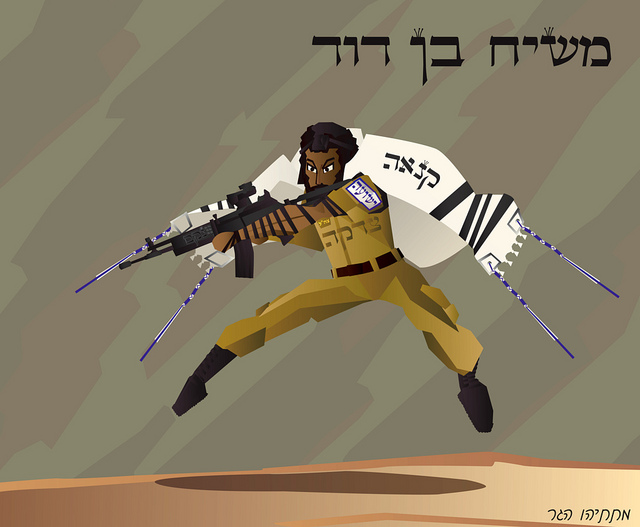
The Mashiach is an intriguing personality; so much so that, in the early stages of the redemption, he himself will not be aware of the role HaShem has placed upon him in Jewish and world history.
When the Mashiach first appears, will he be donning a knitted kippah, a black velvet one, a shtreimel or perhaps no kippah at all?
by Rabbi Nachman Kahana | Dec 6, 2016
Normal people place great value on having children. But in our parasha the desire for children and the joy and delight exhibited by our grandmothers Rachel, Leah, Bilha and Zilpa upon the birth of their children go beyond the natural feeling of motherhood.
Their delight was in the knowledge that they were chosen to be a major part in the biggest saga in human history – they were to bring into this world the beginning of the 12 tribes which would comprise Am Yisrael.

